


Planning a trip to Borjomi Georgia? Skip the sanitized, high-priced travel brochures. This unfiltered Borjomi travel guide covers how to survive the famous Soviet spa town Georgia keeps on life support, where to dodge overpriced hotel bars, and how to find the real historical reality behind the imperial myth—all based on a wild, muddy weekend getaway.
My friend Oskars and I went down to Borjomi the other weekend. It is always its own bizarre, surreal (in the post-apocalyptic sense) experience—a lush pine valley where you drink warm, fizzy Borjomi mineral water that tastes like a handful of wet copper pennies. It is the legendary hangover-killing magic of the Caucasus: but opening a bottle on a bumpy marshrutka ride is a highly combustible gamble that could leave your pants looking like you've been in a sweaty tin can.
This time, we were there on an overnight meetup with other European Business Association members (we were representing Developers Alliance). We were supposed to divide into groups, but mostly it was the accountants who showed up—so the stragglers separated off for their own walks and searches for booze. C’est la vie.

Key Points for Borjomi Travel
The Ticket: The Borjomi Central Park entry fee is around 3 Lari, but if you have a key card from Crown Royal Palace, you can scan through the gates for free.
The Hike: The Borjomi sulfur pools hike is a flat, 4-kilometer trek through the forest—keep an eye out for rogue Nivas kicking up mud on the path. There are changing booths at the pools.
Pack Snacks: The small wooden cabins at the baths sell overpriced snacks and drinks; save your cash and pack your own khachapuri.
The Local Beer: Skip the hotel lounges charging 19 Lari for a basic Argo; buy it at a corner kiosk for under 3 Lari instead.
The Imperial Hangover and the Romanovs
The travel brochures love to paint this valley as a pristine, aristocratic sanctuary "discovered" by the Russian Empire in the 1820s. Empires, of course, are always "discovering" things. Don’t get me started on that word. Of course people were already here, but also other people weren't. The mundane daily reality of one people might be a discovery for another.
Anyway, here is what actually happened: soldiers stationed in the valley to ward off the Ottoman found the springs, realized the bubbly water cured their heavy hangovers, and sent word up the chain of command.

The Romanov royal family caught wind, moved in, built some European-looking palaces, and claimed they founded the place. Now, the grand Romanov palace Borjomi (that is, Likani Palace) is a centerpiece of local historical tours from across a fence, as it has been closed for some time due to "renovation".
But never mind that Georgians had been living in the valley for centuries, surrounded by a ring of medieval castles and monasteries. The only thing the Russian Empire actually invented here was the bottling plant—milking the natural spring for massive imperial profits. And not to mention it was all the rage back then to have a spa town in your empire, just like Spa in Belgium or the grand resorts in Austria. So Russia simply built its own version right here.
The Canal Walk and the "Cold" Spring
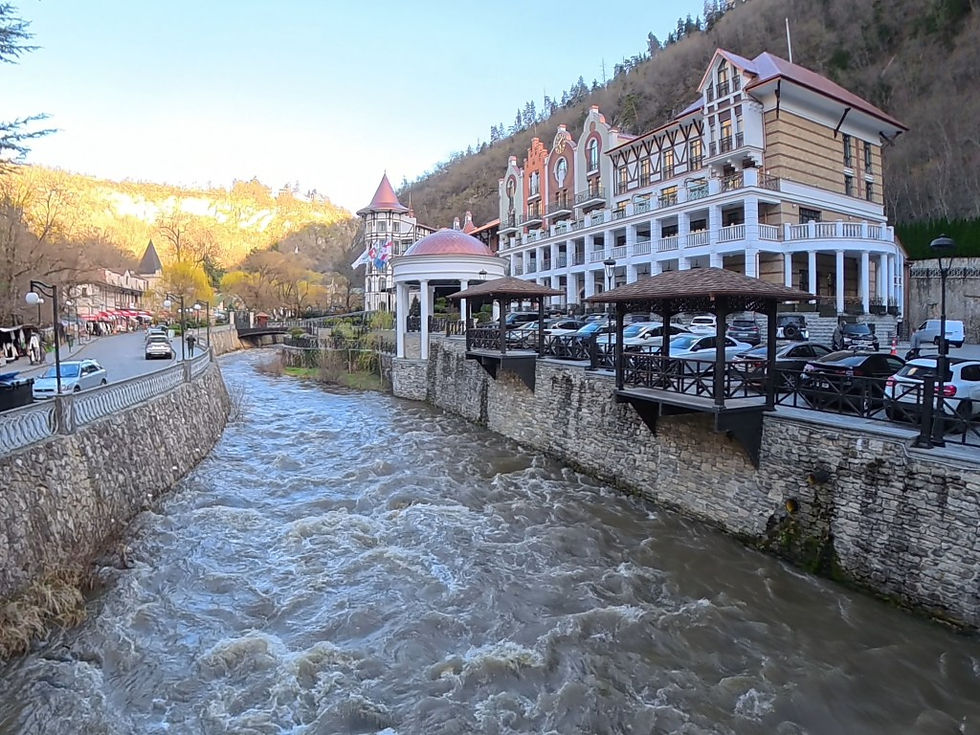
To get to the famous waters in town, you first have to take a walk on the canal.
Today, it is a somewhat empty path with occasional tourists and stalls selling cheap, plastic Chinese toys and fur coats(?!). It used to be filled with neat local restaurants and bars, but now it is mostly a plastic gauntlet. If you are looking for actual, engaging things to do in Borjomi rather than dodging cheap souvenirs... then you'll have to rent a car and go see some castle or sanatarium ruins nearby.
View up Borjomi canal to Crown Palace View from Royal Palace looking away from Borjomi Park
On our trip, some colleagues scouted out a local wine cavern, but they deemed it "unsuitable" for the crowd of lawyers, accountants, and business types who were there for our conference. If it had been just me and Oskars, we would have jumped right in—and this story would probably have a slightly different tone.
If you want a free, quick shot of the curative stuff without paying the park fee, look behind the last row of buildings before the main gates. Down on the last slice of boardwalk, you will find the water faucet. This is the "Cold Spring." It isn’t the hot stuff, as it has been running through an underwater pipe for some distance at this point.
In the olden days, there was just a dirty communal cup sitting on the stone for everyone to share. Today, you will have to bring your own bottle (don't worry, you can buy one on the street). Fill it up, ignore the heavy copper taste, and let the minerals do their magic on yesterday's chacha.

The Golden Pavilion and the Lukewarm Forest Walk
Inside the park gates, the real source lives under a grand, glass-domed pavilion.
The water here is warm—faintly thermal, surprisingly flat, and smelling heavily of sulfur. It is an acquired taste, to put it politely. If you want a different view of the park, you can take the cable car at the entrance up to the weird Soviet-style amusement park on the plateau.
If you are looking for the thermal sulfur baths, though, prepare for the Borjomi sulfur pools hike:
Walk past the pavilion and follow the dirt nature trail into the forest.
Keep your ears open for local drivers in old Nivas tearing up the mud roads where they absolutely should not be driving.
Arrive at the stone pools after a 45-minute walk.
The pools themselves are lukewarm, not hot. If you visit in the chilly off-season, you will likely spend the entire time shivering in a changing booth (yes, there are changing booths). Skip the swim if it is cold, enjoy the forest air, and head back to town. Borjomi is not exactly Georgia off the beaten path—it has been a tourist magnet since the 19th century—but you can still find pockets of quiet forest if you hike far enough.
The Crown Palace Saga
Borjomi is packed with dated hotels that use grandiose names to hide their Soviet-era bones. Take the Crown Palace: it has neither a crown, nor a palace, nor anything remotely royal.
The rooms are boring, the buffet is okay but mostly cold—though the pastries are tasty—and the air conditioning is controlled by a central system that apparently shuts off at midnight.
We found ourselves calling a security guard at 1:00 AM just to get him to unlock our window with a special key so we did not suffocate. Were they afraid of jumpers? "Nothing to do in Borjomi, I'm outta here!"
But the real crown of the palace is the bar.
Because there are few late-night spots nearby, the hotel acts like an airport terminal, charging an absurd 19 Lari for an Argo beer. Argo is a basic, commercial lager—the kind of beer you can buy at a corner kiosk for 3 Lari.
When I first came to Georgia, I hung out at a place that sold Argo for 3 Lari. Shoutout to Salve, by the way—the OG bar for all of us foreign hipster types. It is now called Makulatura, still in the same place on Dadiani in Tbilisi. Go check it out to witness how we old volunteers and journalists used to hang out.

To top off the absurdity at the Crown Palace, the staff forgot to charge us for our beers at checkout. Days later, they were hounding Oskars' phone on WhatsApp to collect their overpriced 19 Lari. They paid less than 3 Lari for that bottle! You don't need to chase down guests for your own checkout screw-up.
If you want a real drink, skip the hotel bar. Go to the local shops, buy a cold beer for a fraction of the price, and sit by the river.
The Ghost Train and the Future of the Valley
Borjomi has incredible bones. The nature is stunning, the river is wide, and the air is clean. But right now, it feels like a town waiting for a spark.
It has the potential to be a playground like Cesky Krumlov in the Czech Republic—a place with kayaking, back-alley art museums, and thriving local pubs. Instead, it is mostly rundown hotels and kids' playgrounds next to a roaring highway.
There is hope on the horizon, though.
The Kukushka—an old, rickety Soviet train that chugs over a spectacular bridge designed by Gustave Eiffel—has been out of service for years. It was a true, shaking adventure ride. Rumor has it that the Kukushka train Borjomi 2026 season is finally going to happen, and the line is planning its grand reopening.
Until then, go for the fresh air, drink the weird copper water, laugh at the absurdity of the crowds, and enjoy the mountains on your own terms.
Frequently Asked Questions
Is Borjomi mineral water good for hangovers?
Yes. The high mineral content and natural carbonation make it a legendary hangover cure across Eastern Europe. Drinking it warm straight from the source in Borjomi Central Park is highly effective, even if the metallic taste takes some getting used to.
How do I get to the Borjomi sulfur pools?
The sulfur pools are located at the end of the Borjomi sulfur pools hike, which is a 4-kilometer nature trail starting from the back of Borjomi Central Park. It is an easy, flat walk that takes about 45 minutes. Watch out for local drivers navigating Jeeps along the muddy path.
How much is the Borjomi Central Park entry fee?
The Borjomi Central Park entry fee is approximately 3 Lari. However, some hotels in the area offer free park access to their guests via their room key cards.
What is the Kukushka train Borjomi 2026 update?
The Kukushka is a historic, narrow-gauge railway line that runs between Borjomi and Bakuriani, famous for crossing a scenic bridge designed by Gustave Eiffel. While it has been out of service recently, local authorities are preparing the tracks with plans to finally reopen the line for the Kukushka train Borjomi 2026 season.
Ready to explore Georgia without the tourist fluff? Skip the generic travel-agency packages. I'm working on a new book about Georgian toasting and the grand tradition of the supra. If you have local expertise to share, let's talk. Otherwise, download my self-guided audio tours of Tbilisi—covering the Old Town, Rustaveli, and Chugureti—to navigate the capital like an outlander who actually knows the subtext.


